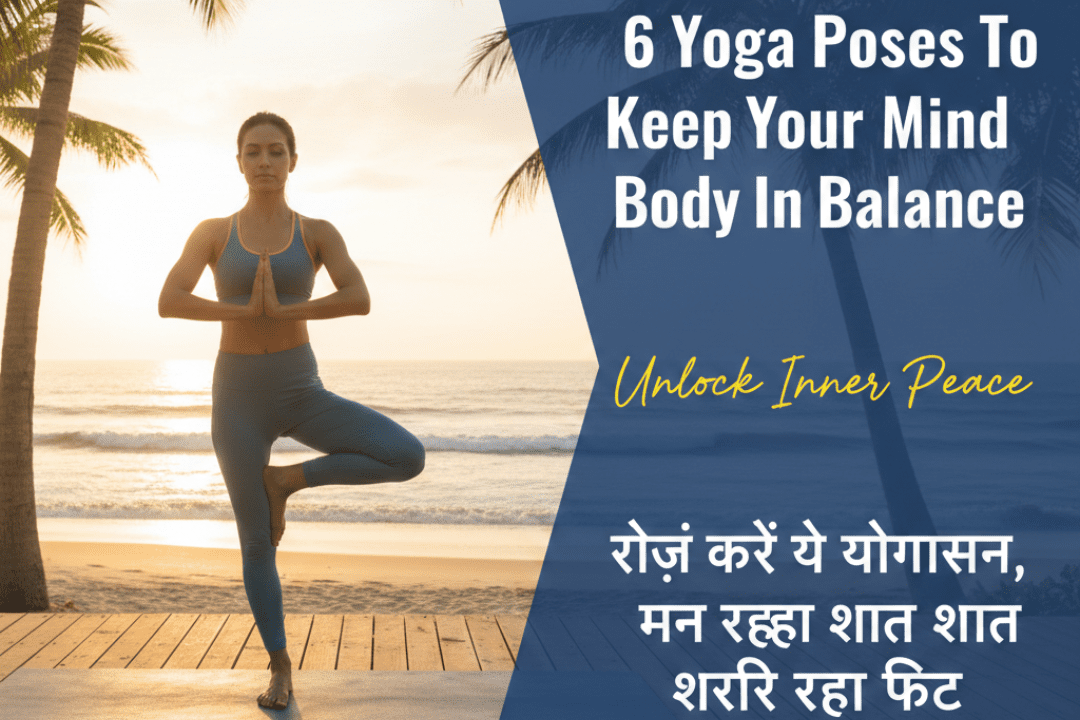
Discover 6 powerful yoga poses to keep your mind and body in balance. Practice these daily yogasanas for mental peace, physical fitness, and overall well-being. रोज़ करें ये योगासन और पाएं शांत मन और फिट शरीर।
In today’s fast-paced world, stress, anxiety, and physical fatigue have become constant companions. Whether you’re dealing with a demanding job, family responsibilities, or simply the pressures of modern life, finding balance between mental peace and physical health is more important than ever.
Yoga — the ancient Indian practice of breath, movement, and mindfulness — offers a proven path to achieving that balance. Unlike intense gym workouts or crash diets, yoga works holistically. It nurtures your nervous system, strengthens your muscles, improves flexibility, and calms your racing mind — all at the same time.
In this article, we’ll explore 6 highly effective yoga poses (yogasanas) that you can practice every day to keep your mind calm and your body fit. These poses are suitable for beginners and experienced practitioners alike, and require no special equipment — just a yoga mat and a few minutes of your time.
Why Daily Yoga Practice Matters (Benefits at a Glance)
Before diving into the poses, here’s why adding yoga to your daily routine is one of the best decisions you can make for your health:
- Reduces stress and anxiety by lowering cortisol levels
- Improves flexibility and strength with consistent practice
- Enhances focus and mental clarity through breathwork and mindfulness
- Boosts immunity by stimulating the lymphatic system
- Promotes better sleep and faster recovery
- Regulates blood pressure and supports heart health
- Balances hormones and improves digestive health
Now, let’s get into the 6 yoga poses that can transform your daily life.
1. Tadasana (Mountain Pose) — The Foundation of Balance
Sanskrit Name: Tadasana (ताड़ासन) Best Time to Practice: Morning, on an empty stomach Duration: Hold for 30–60 seconds, repeat 5 times
How to Do Tadasana:
- Stand with your feet together, toes touching, and heels slightly apart.
- Distribute your weight evenly across both feet.
- Engage your thigh muscles and lengthen your spine upward.
- Roll your shoulders back and down, opening your chest.
- Let your arms hang naturally by your sides, palms facing forward.
- Lift the crown of your head toward the ceiling.
- Breathe slowly and deeply. Hold the pose with awareness.
Benefits of Tadasana:
- Improves posture and alignment
- Strengthens thighs, knees, and ankles
- Increases awareness and concentration
- Helps relieve sciatica and flat feet
- Creates a sense of groundedness and mental stability
Tip: Tadasana may look simple, but it trains your body to stand tall and your mind to be present. It is the starting point for many standing yoga poses.
2. Vrikshasana (Tree Pose) — Build Focus and Inner Strength
Sanskrit Name: Vrikshasana (वृक्षासन) Best Time to Practice: Morning or evening Duration: Hold for 30–60 seconds on each side
How to Do Vrikshasana:
- Start in Tadasana. Shift your weight onto your left foot.
- Bend your right knee and place the right foot on the inner left thigh (above the knee).
- Press the foot and thigh firmly against each other.
- Bring your palms together in a prayer position (Namaste) at your chest.
- Fix your gaze on a point in front of you (drishti) to maintain balance.
- Raise your arms overhead if comfortable, keeping the palms together.
- Hold, breathe, and then switch sides.
Benefits of Vrikshasana:
- Improves balance and coordination
- Strengthens the legs, hips, and core muscles
- Enhances concentration and mental focus
- Calms the nervous system
- Builds confidence and a sense of stability
Tip: If balancing is difficult at first, place your foot against your calf instead of your thigh. Never place your foot directly on the knee joint.
3. Balasana (Child’s Pose) — The Ultimate Stress Reliever
Sanskrit Name: Balasana (बालासन) Best Time to Practice: Anytime — especially during or after stressful moments Duration: Hold for 1–3 minutes
How to Do Balasana:
- Kneel on your mat with your knees hip-width apart.
- Sit back on your heels.
- Extend your arms forward and lower your forehead to the mat.
- Let your chest rest between or over your thighs.
- Close your eyes and breathe deeply into your back body.
- Surrender fully into the pose, letting go of all tension.
Benefits of Balasana:
- Instantly calms the mind and reduces anxiety
- Gently stretches the hips, thighs, and lower back
- Relieves fatigue and tension in the shoulders and neck
- Activates the parasympathetic nervous system (rest-and-digest mode)
- Provides a sense of safety, comfort, and surrender
Tip: This pose is perfect when you feel overwhelmed or exhausted. Even 60 seconds in Balasana can dramatically shift your mental state.
4. Bhujangasana (Cobra Pose) — Energize and Open Your Heart
Sanskrit Name: Bhujangasana (भुजंगासन) Best Time to Practice: Morning, after warm-up stretches Duration: Hold for 15–30 seconds, repeat 3–5 times
How to Do Bhujangasana:
- Lie flat on your stomach with your legs extended and feet together.
- Place your palms flat on the mat under your shoulders, elbows close to your body.
- Press the tops of your feet, thighs, and hips firmly into the floor.
- Inhale and slowly lift your chest off the floor, using your back muscles (not just your arms).
- Straighten your arms as much as your flexibility allows, keeping a slight bend in the elbows.
- Roll your shoulders back, open your chest, and gaze forward or slightly upward.
- Hold, then exhale and lower back down.
Benefits of Bhujangasana:
- Strengthens the spine and back muscles
- Opens the chest and improves lung capacity
- Stimulates the digestive organs and kidneys
- Tones the buttocks and relieves sciatica pain
- Boosts energy, confidence, and mood
- Helps combat depression and fatigue
Tip: Don’t force your body into a deep backbend. A gentle lift that uses back strength is far more beneficial than an extreme arch that strains the lower back.
5. Setu Bandhasana (Bridge Pose) — Strengthen, Restore, and Rebalance
Sanskrit Name: Setu Bandhasana (सेतु बंधासन) Best Time to Practice: Morning or evening Duration: Hold for 30–60 seconds, repeat 3 times
How to Do Setu Bandhasana:
- Lie on your back with your knees bent and feet flat on the floor, hip-width apart.
- Place your arms by your sides, palms facing down.
- Press your feet firmly into the floor.
- Inhale and lift your hips toward the ceiling, engaging your glutes and core.
- Clasp your hands beneath your body and press your arms into the mat to open your chest further.
- Keep your thighs parallel and your knees over your ankles.
- Hold, breathe, then exhale and slowly lower your spine back to the mat, one vertebra at a time.
Benefits of Setu Bandhasana:
- Strengthens the back, glutes, and hamstrings
- Opens the chest, neck, and spine
- Stimulates the thyroid gland and improves metabolism
- Calms the brain and helps relieve mild depression and anxiety
- Improves digestion and blood circulation
- Reduces menstrual discomfort and symptoms of menopause
Tip: This pose is a wonderful antidote to the hours we spend hunched over screens. Practice it daily for a healthier spine and a lighter mood.
6. Shavasana (Corpse Pose) — The Most Important Pose of All
Sanskrit Name: Shavasana (शवासन) Best Time to Practice: At the end of every yoga session Duration: 5–15 minutes
How to Do Shavasana:
- Lie flat on your back with your legs extended and feet falling naturally outward.
- Place your arms at your sides, palms facing upward, fingers gently curled.
- Close your eyes and let your body completely relax into the floor.
- Release all tension from your toes, feet, calves, thighs, hips, abdomen, chest, shoulders, arms, hands, neck, and face.
- Breathe naturally. Do not control or direct your breath.
- Let your mind become still. If thoughts arise, simply observe them without engaging.
- Remain in total stillness for 5–15 minutes.
- To come out, first wiggle your fingers and toes, take a deep breath, and gently roll to one side before sitting up.
Benefits of Shavasana:
- Deeply relaxes the entire nervous system
- Reduces blood pressure, heart rate, and cortisol levels
- Integrates the benefits of the yoga session into the body
- Promotes mental clarity and emotional resilience
- Relieves insomnia and fatigue
- Cultivates the ability to be present and at peace
Tip: Many people underestimate Shavasana because it “looks easy.” But the art of consciously letting go — of the body, breath, and mind — is one of the most profound and challenging practices in yoga.
A Simple Daily Yoga Routine Using These 6 Poses
Here’s how you can combine these 6 poses into a balanced 20–30 minute morning routine:
| Pose | Duration | Purpose |
|---|---|---|
| Tadasana | 2 minutes | Grounding and awareness |
| Vrikshasana | 3 minutes (each side) | Balance and focus |
| Bhujangasana | 3 minutes (with repetitions) | Energize and strengthen the back |
| Setu Bandhasana | 3 minutes (with repetitions) | Core strength and heart opening |
| Balasana | 2 minutes | Rest and release |
| Shavasana | 5–10 minutes | Integration and deep rest |
Total Time: Approximately 20–25 minutes
Tips for Getting the Most Out of Your Daily Yoga Practice
Practice on an empty stomach. Ideally, wait 2–3 hours after a meal before doing yoga.
Use a good quality mat. A non-slip yoga mat provides the support and stability your practice needs.
Be consistent, not intense. 20 minutes every day is far more beneficial than an intense 2-hour session once a week.
Breathe consciously. In yoga, breath is everything. Never hold your breath during a pose.
Listen to your body. Yoga is not a competition. Honor your body’s limits and progress gradually.
Practice in a clean, quiet space. Minimize distractions to keep your mind focused.
Combine yoga with pranayama (breathwork). Adding 5–10 minutes of deep breathing or Anulom Vilom before your practice enhances the mental benefits significantly.
Conclusion: The Path to a Balanced Life Starts on the Mat
Yoga is not just a form of exercise — it is a way of life. When you commit to practicing these 6 yoga poses every day, you are making a powerful investment in both your physical health and your mental well-being.
From the grounding stillness of Tadasana to the complete surrender of Shavasana, each pose offers unique gifts: strength, flexibility, focus, calm, and balance. Together, they create a complete practice that touches every dimension of your being.
Start today. Start with just one pose. And let yoga guide you toward a life of greater peace, vitality, and balance.